





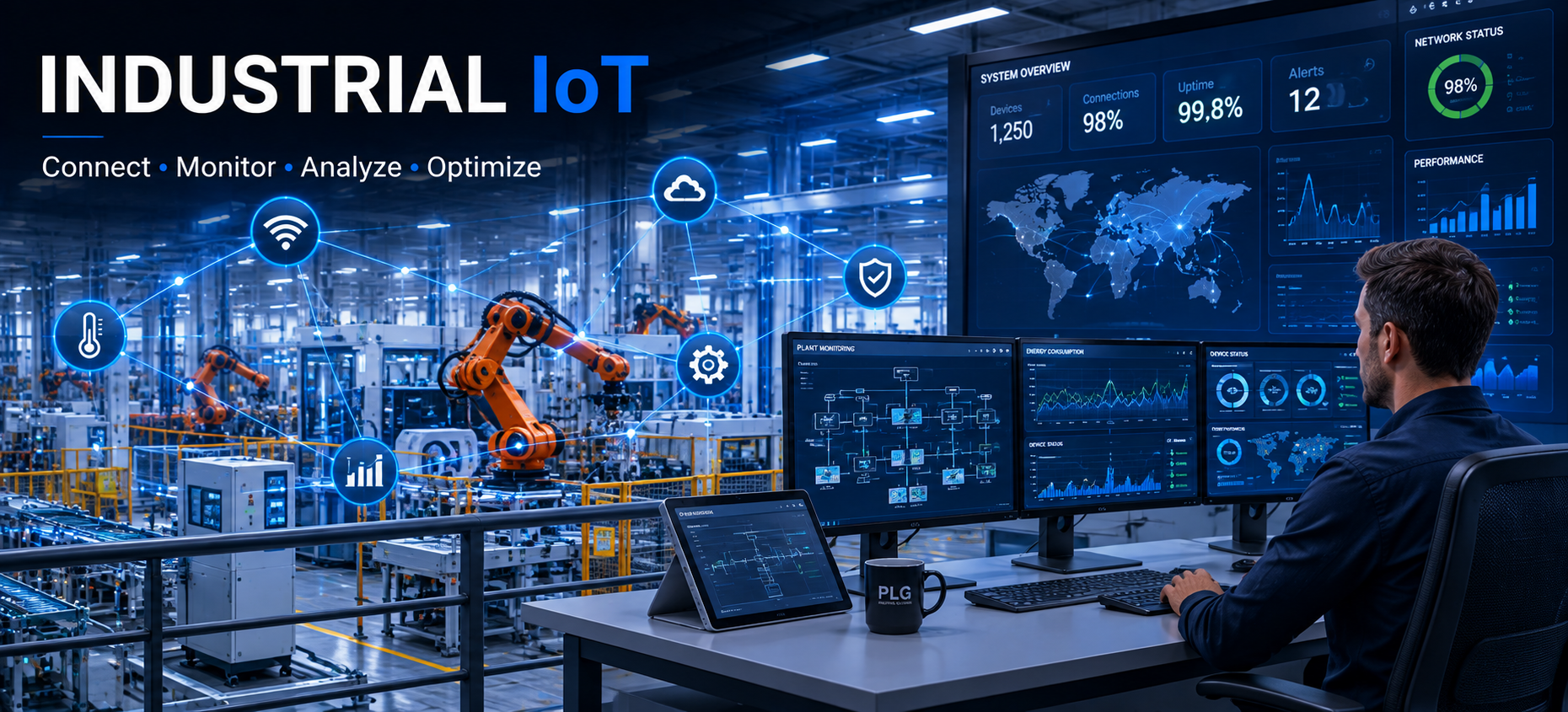
GPLG develops Industrial IoT solutions that connect machines, sensors and industrial equipment with software systems, enabling companies to collect, monitor and use operational information more effectively.
From individual machines to connected production environments, we design IoT architectures around the requirements of the industrial process.
Discuss an IoT Project
Modern industrial equipment generates significant amounts of information.
Machine status, temperatures, production counts, energy consumption, cycle times, alarms and other operating parameters can provide valuable insight into the production process.
Industrial IoT creates the infrastructure required to collect this information from the physical environment and make it available to the software systems that need it.
GPLG designs IoT solutions that connect:
The objective is not simply to collect more information.
It is to make industrial information usable.
From Industrial Equipment to Connected Systems
An Industrial IoT architecture provides a structured way to collect information from industrial assets and make that information available to higher-level systems.
The architecture can be small and focused on a single machine or expanded across an entire production environment.
WHAT WE CONNECT
Machines
Connect existing and new industrial machinery to collect relevant operating information.
PLC Systems
Acquire selected process information from industrial control systems.
Sensors
Temperature, pressure, vibration, load, energy and other industrial measurements.
CNC Equipment
Connect machining environments to collect relevant production and operational information.
Robotics
Collect information from robotic systems and automated cells.
Production Lines
Connect multiple machines and systems to create a more comprehensive view of the production process.
INDUSTRIAL DATA ACQUISITION: Collecting the Right Information
IoT begins with understanding what information is actually required. Depending on the application, GPLG can design data acquisition around parameters such as:
Modernising Equipment Without Replacing Everything
Many factories contain machines from different generations. Replacing an entire production line simply to obtain modern connectivity is not always practical.
Industrial IoT can provide a way to connect existing equipment to newer digital systems.
Processing Information Close to the Machine
Not every application requires all information to be transferred to a central system. Edge computing allows certain processing tasks to take place close to the industrial equipment.
Designed Around the Existing Automation System
GPLG designs the IoT layer as part of the wider automation architecture.
The objective is to ensure that machines, control systems, and digital applications work together rather than creating another isolated technology layer.
🖥️
IoT and Industrial Supervision
Industrial IoT can provide additional data to supervision and monitoring systems, expanding the amount of operational information available to operators and engineering teams.
Turning Machine Information Into Usable Data
IoT systems can transform information generated by industrial equipment into structured data that can be used by other applications. This can support:
Connected Data Creates Opportunities for Intelligence
Once industrial information is available in a structured form, it can become a source for more advanced applications.
Connecting Visual Information to Industrial Systems
Industrial cameras can also become part of a connected industrial environment.
INDUSTRIAL MONITORING
Know What Is Happening Across the Factory
Industrial IoT can provide a more comprehensive view of equipment and processes.Depending on the system architecture, companies can monitor:
Production
What is being produced?
Equipment
Which machines are operating?
Performance
How efficiently are machines operating?
Conditions
Are operating parameters within expected ranges?
Energy
How much energy is being consumed?
Events
What alarms, interruptions or abnormal conditions have occurred?
INDUSTRIAL IoT APPLICATIONS
Production Monitoring
Connect machines and production equipment to monitor operational information.
Machine Monitoring
Track operating conditions and machine status.
Energy Monitoring
Collect and analyse energy-related information.
Predictive Maintenance
Provide the data infrastructure required for predictive maintenance applications.
Remote Monitoring
Make selected industrial information available remotely where appropriate.
Factory Connectivity
Connect multiple machines and systems into a unified industrial information architecture.
Building a More Connected Factory
Industrial IoT is one of the foundations of modern smart manufacturing. A connected production environment can provide a clearer relationship between:
From Existing Equipment to Connected Factory
Transitioning to a connected environment requires a structured methodology. GPLG uses a professional 7-step process to integrate IoT capabilities reliably.
Technologies Used Within Our IoT Architecture
Industrial Connectivity Requires a Controlled Architecture
Connecting industrial equipment to digital networks must be done carefully. GPLG considers critical architectural factors to ensure seamless integration:
Our Approach to Industrial IoT
Connect Your Industrial Environment
Whether you need to connect a single machine, modernise existing equipment or create a connected production environment, GPLG can design and implement the appropriate Industrial IoT architecture.