





bg test 12

Machine Vision Technologies

Machine vision1
Industrial Vision Systems for Inspection, Identification and Automation

👁️

Machine Vision Systems & Industrial Integration

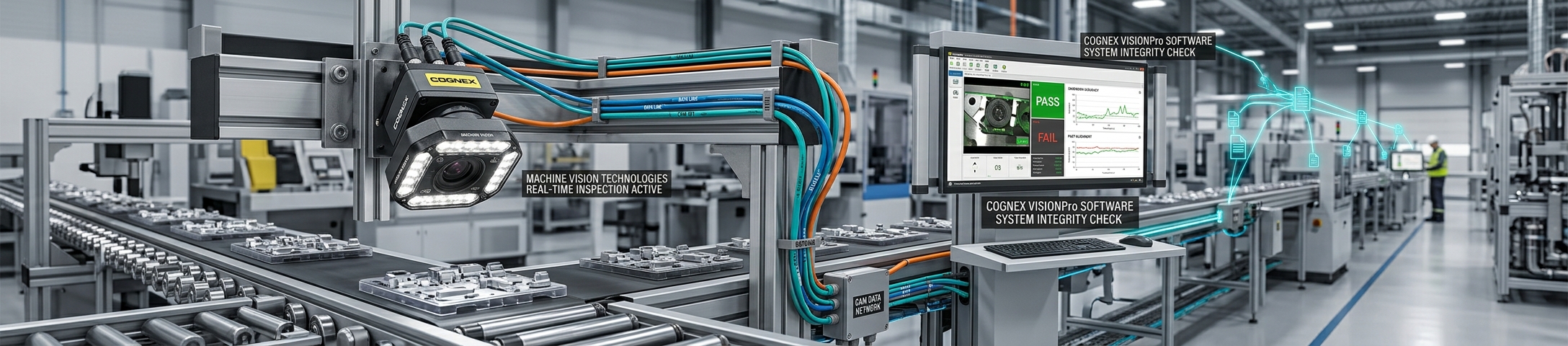
GPLG designs and integrates machine vision systems that allow industrial equipment to capture, analyze, and act on visual information in real time.

Core Vision Applications
🔍
Product Inspection
Automated surface, defect, and assembly verification to ensure zero-defect production.
📐
Measurement & Metrology
High-precision dimensional checks and geometric tolerances directly on the line.
🏷️
Object Identification
1D/2D code reading, OCR text extraction, and automated part classification.
🤖
Robotic Guidance
2D/3D spatial coordinates feeding pick-and-place and flexible assembly robots.

Integrated Solution Stack
📷 Cameras
🔍 Optics
💡 Lighting
🧠 Image Processing
⚡ Industrial Automation

MACHINE VISION ENGINEERING

OPTICAL INTELLIGENCE Giving Industrial Systems the Ability to See

Machine vision transforms images captured by industrial cameras into information that can be used by machines, software and automation systems. A complete vision system is much more than a camera.

The performance of the application depends on the correct combination of optical elements, hardware acquisition, and automated decision-making.

VISION PIPELINE ARCHITECTURE
Camera
Lens
Lighting
Image Acquisition
Processing
Decision
Automation
SYSTEM INTEGRATION Tailored Optical Engineering

GPLG engineers the complete system around the characteristics of the product, production environment and inspection requirement. Every variable is accounted for to guarantee absolute repeatability.

DEPLOYMENT MODEL
Standard Standalone Cameras
Fully Integrated Vision & Control Ecosystem
GPLG STANDARD
A reliable vision system begins with the right engineering—not simply with a high-resolution camera.
WHAT IS MACHINE VISION?
🔄

From Image to Industrial Decision

A machine vision system captures visual information, processes the image, and produces a real-time result utilized by the broader industrial automation infrastructure.

Technical Architecture Pipeline
🏭 Process
📦 Product
📷 Camera
🖼️ Acquisition
⚙️ Processing
🧠 Analysis
DECISION
✓ PASS / OK ✗ FAIL / NOK
🤖 Automation
Application Results & Outputs
📐 Measurement
🏷️ Identification
🗂️ Classification
📍 Position
Quality Result
🎯 Pass / Fail Decision
🤖 Robot Coordinates
MACHINE VISION COMPONENTS
🛠️

Engineering the Complete Vision System

📷
Industrial Cameras
Selection of appropriate cameras according to resolution, speed, sensor characteristics, and application requirements.
🔍
Optics & Lenses
Lens selection determines how the camera sees the object. Correct field of view, working distance, and optical characteristics are essential for reliable inspection.
💡
Industrial Lighting
Lighting is one of the most important parts of a vision system. We select lighting according to geometry, material, surface, and inspection objectives.
🖼️
Image Acquisition
We design the acquisition process to capture consistent, high-quality images reliably at the required production line speed.
⚙️
Image Processing
Images are processed and analyzed through algorithms to extract the precise information required by the industrial application.
Industrial Integration
The vision result is seamlessly integrated with PLCs, robots, machinery, or higher-level industrial software where required.
CAMERA TECHNOLOGY
📷

Selecting the Right Industrial Camera

There is no single camera that is ideal for every application. GPLG evaluates the specific demands of each deployment to obtain the required image quality—not simply the highest specification available.

Camera Evaluation Criteria
🔍 Required Resolution
📏 Object Size
Inspection Speed
📐 Field of View
🔭 Working Distance
🎨 Colour Requirements
Monochrome Requirements
⏱️ Exposure Time
🏃 Motion Dynamics
🛡️ Environmental Conditions
LENSES & OPTICS
🔍

The Lens Is Part of the Measurement System

A high-quality camera cannot compensate for an unsuitable lens. Optical accuracy directly defines system performance.

Key Optical Factors Evaluated
📐 Field of View
🔭 Working Distance
🔍 Magnification
🌐 Distortion Control
↕️ Depth of Field
📏 Object Dimensions
📷 Camera Sensor Characteristics
Core Engineering Principle: Camera and optics must be engineered as a single, unified system.
INDUSTRIAL LIGHTING
💡

Controlling the Image Before Processing It

Lighting determines what the camera can actually see. Different materials, surface finishes, and component geometries demand specific lighting techniques to highlight key features and eliminate unwanted visual noise.

🔳
Backlighting
Useful for high-contrast silhouettes, precise dimensional measurement, and edge profiles.
Ring Lighting
Suitable for general surface inspection and multi-directional component illumination.
Bar Lighting
Useful for larger inspection areas and producing targeted directional illumination.
🌐
Dome Lighting
Provides diffuse illumination to drastically reduce hot-spot reflections on curved or shiny surfaces.
👁️
Coaxial Lighting
Directs light along the optical axis, making it highly effective for flat, highly reflective surfaces.
🛠️
Custom Lighting
Purpose-designed lighting arrangements tailored specifically for unique or complex application constraints.
Core Vision Rule: Good vision starts with good illumination.
IMAGE ACQUISITION
⏱️

Capturing Consistent Images at Production Speed

Industrial inspection demands highly repeatable image acquisition. To prevent variability, image acquisition is precisely engineered around the physical dynamics of the actual production cycle.

Timing & Motion Factors Evaluated
Triggering
📸 Exposure
🏃 Motion
🔄 Image Frequency
🔗 Camera Synchronisation
🛞 Conveyor Speed
📍 Product Position
💡 Lighting Timing
⚠️
Key takeaway: A system that produces inconsistent images will produce inconsistent inspection results.
IMAGE PROCESSING
⚙️

Extracting Information From Images

Once an image is captured, the system extracts the critical visual data. GPLG selects and combines the appropriate algorithmic approaches based specifically on the inspection goals.

Image Processing & Analysis Techniques
🧹 Filtering
🎚️ Thresholding
🧩 Segmentation
📐 Edge Detection
🔷 Shape Analysis
〰️ Contour Analysis
🎯 Pattern Matching
📏 Measurement
📦 Object Detection
🏷️ Classification
AI & MACHINE VISION

MACHINE VISION ENGINEERING

OPTICAL INTELLIGENCE Giving Industrial Systems the Ability to See

Machine vision transforms images captured by industrial cameras into information that can be used by machines, software and automation systems. A complete vision system is much more than a camera.

The performance of the application depends on the correct combination of optical elements, hardware acquisition, and automated decision-making.

VISION PIPELINE ARCHITECTURE
Camera
Lens
Lighting
Acquisition
Processing
Decision
Automation
SYSTEM INTEGRATION Tailored Optical Engineering

GPLG engineers the complete system around the characteristics of the product, production environment and inspection requirement. Every variable is accounted for to guarantee absolute repeatability.

DEPLOYMENT MODEL
Standard Standalone Cameras
Fully Integrated Ecosystem
GPLG STANDARD
A reliable vision system begins with the right engineering—not simply with a high-resolution camera.
QUALITY INSPECTION

Automated Visual Quality Control

Machine vision can automate inspections that would otherwise require manual visual checking. Applications may include:

📦
Presence & Absence
Determine whether a component is present.
⚙️
Assembly Verification
Verify that components have been assembled correctly.
🔍
Surface Inspection
Identify visible defects or irregularities.
📏
Dimension Verification
Measure components and compare them against defined requirements.
🏷️
Label & Mark Inspection
Verify printed information, codes or markings.
🗂️
Product Classification
Classify products according to visual characteristics.
MEASUREMENT & DIMENSIONAL INSPECTION
📐

Vision-Based Measurement

Machine vision performs non-contact measurements when the application and optical configuration are properly suited. Accuracy depends on the complete optical and imaging system, precision calibration, and controlled application conditions.

Capable Non-Contact Measurements
📏 Length
↔️ Width
Diameter
📍 Position
↕️ Distance
📐 Angles
🔷 Shape
🎯 Alignment
OBJECT DETECTION & IDENTIFICATION
🎯

Finding and Identifying Objects

Vision systems reliably locate and identify objects within a defined inspection area. For robotic applications, the system provides precise spatial coordinates required for automated guidance and pick-and-place handling.

🔍
Component Detection
Detect the presence, absence, or features of components in the field of view.
🏷️
Product Identification
Identify specific product variants, markings, or visual identifiers accurately.
🧭
Orientation Detection
Determine angular position and rotational alignment before handling or assembly.
📍
Part Localisation
Pinpoint precise coordinates $(X, Y, \theta)$ to guide robotic systems and pick-and-place tools.
🔢
Object Counting
Count items rapidly in bulk or continuous flow setups with high repeatability.
🗂️
Classification
Sort and categorize parts automatically according to visual profile and geometry.
🤖
Robotic Guidance: Beyond inspection, the vision system outputs accurate spatial positional data to trigger and guide automated motion systems and industrial robots.
VISION-GUIDED ROBOTICS

Connecting Vision With Robotic Automation

This is where Machine Vision connects directly to your Robotics Integration service. Vision-guided robotics allows automated systems to respond dynamically to objects whose position or orientation may vary on the production line.

Integrated Control Pipeline
Camera
Image Processing
Object Detection
Position / Orientation
Robot Controller
Robot
Pick / Place / Sort
GPLG seamlessly bridges the vision system with the robot controller and surrounding automation architecture to deliver flexible, dynamic handling.
VISION + PLC

Integrating Inspection Results With Automation

A machine vision system often needs to communicate its result directly to the machine control system. The PLC remains responsible for the deterministic machine-control logic while the vision system provides the visual information required by the application.

Integration Pipeline
Camera
Vision System
Inspection Result
PLC
Machine Decision
Reject / Accept / Stop / Continue
Deterministic control and high-speed image analysis work together in a synchronized environment to execute automated actions without slowing down line speed.
VISION + INDUSTRIAL SOFTWARE

Bringing Vision Information Into Software

Vision results can also become part of wider industrial applications. Integrating visual inspection data directly into higher-level management systems transforms isolated image captures into actionable production insights across the enterprise.

Software Integration Pipeline
Inspection Result
Industrial Software
Production Record
Analysis / Reporting
This allows inspection results to become a vital component of the broader manufacturing information system, driving traceability, quality assurance, and long-term process optimization.
MACHINE VISION APPLICATIONS

Where We Apply Machine Vision

Quality Inspection

Automated visual inspection of products and components to detect surface defects, material flaws, and assembly errors at production line speeds.

Product Identification

Recognition and classification of parts and products using optical character recognition (OCR), 1D/2D barcodes, and feature matching.

Measurement

Non-contact dimensional and positional measurement ensuring exact physical tolerances and real-time geometric verification without part contact.

Robotic Guidance

Providing robots with real-time object location and orientation coordinates for precise pick-and-place, assembly, and path correction.

Sorting

Visual classification for automated sorting, categorizing items dynamically based on color, shape, size, or specific visual criteria.

Production Verification

Verification of assembly integrity, component presence, orientation, label positioning, and active process conditions in real time.

MACHINE VISION IMPLEMENTATION

From Inspection Requirement to Production System

Delivering a reliable machine vision solution requires a structured engineering roadmap—moving sequentially from early stage feasibility testing to full-scale industrial commissioning.

01
Application Assessment
Understand the product, manufacturing process, and target inspection criteria.
02
Feasibility
Determine whether machine vision is appropriate and evaluate viable technical strategies.
03
Optical Design
Engineer and select the precise camera, optics, and illumination geometry.
04
Image Acquisition
Develop deterministic hardware/software triggering and high-speed image capture systems.
05
Vision Development
Build and optimize custom image-processing pipelines or AI inspection algorithms.
06
Industrial Integration
Interface system communication directly with PLCs, industrial robotics, cell controllers, or MES software.
07
Validation
Verify accuracy, repeatability, and throughput cycle times under live production conditions.
VISION SYSTEM PERFORMANCE

Designed for Real Production Conditions

A vision system must work consistently—not only when the lighting and product are perfect. GPLG designs and validates each system around the actual operating environment to ensure robust long-term performance.

Product Variation
Handling natural batch-to-batch differences in color, size, surface texture, and shape tolerances.
Production Speed
Maintaining microsecond-accurate triggering and high-speed image processing under maximum line throughput.
Ambient Lighting
Eliminating the effects of changing factory daylight, overhead fixtures, and external light interference.
Reflections
Mitigating glare and specular highlights on metallic, glass, or plastic film surfaces using specialized optics.
Vibration
Stabilizing optical mounts and implementing algorithmic filtering against industrial conveyor or machine noise.
Camera Position
Optimizing physical clearance, working distance, field of view, and mounting rigidity within tight machine spaces.
Product Movement
Accounting for continuous belt motion, part tilt, flutter, or irregular spacing during high-speed travel.
Environmental Conditions
Protecting optics and sensors against factory temperature shifts, dust, oil mist, humidity, and washdowns.
Required Inspection Accuracy
Balancing sub-pixel measurement resolution requirements with line speed and lens distortion limits.
Every optical component, illumination strategy, and processing pipeline is field-hardened and validated under live floor conditions to guarantee industrial-grade reliability.
TECHNOLOGIES WE USE

Machine Vision Technology Stack

Vision
OpenCV
AI / Machine Learning
PyTorch TensorFlow
Development
Python C# / .NET
Industrial Integration
PLC OPC UA MQTT
Infrastructure
Linux Docker
ENGINEERING APPROACH

A Camera Is Only One Part of the Solution

A successful industrial vision project depends on the complete system. GPLG engineers these components together rather than treating the camera as an isolated device.

Product
Lighting
Optics
Camera
Image Processing
Decision
Automation
We don't simply install cameras. We engineer complete machine vision systems.

Give Your Industrial System the Ability to See

From automated inspection and measurement to object recognition and robotic guidance, GPLG designs machine vision systems around real production requirements.

Discuss a Vision Project

Share with