




GPLG · INDUSTRIAL SUPERVISION
SCADA Systems
Industrial supervision built around the way your process actually operates.
GPLG develops SCADA systems that transform industrial data into clear operational information. We connect equipment, control systems and data sources to give operators, maintenance teams and production managers a structured view of the process — from live operating conditions to alarms, trends and production history.
FROM INDUSTRIAL DATA TO OPERATIONAL INFORMATION
A clear view of what is happening in your process
Industrial installations generate information continuously. PLCs, sensors, drives, machines and other control devices know what is happening at field level, but that information must be organised before it becomes useful to the people responsible for production.
A SCADA system provides that operational layer. It brings process values, equipment states, commands, alarms, events and historical information into a structured environment where operators can supervise the installation and engineering teams can investigate its behaviour.
At GPLG, the SCADA application is developed around the process itself. The objective is not simply to place data on screens, but to present the right information in a form that supports operation, diagnosis and technical decision-making.
OPERATIONAL SUPERVISION
Supervision that supports daily operation
Process visualisation
Readable process screens bring machine states, measured values, operating modes and relevant commands together. The interface is organised around the installation so operators can understand process conditions without searching through unnecessary information.
Alarms and events
Structured alarm handling helps teams identify abnormal conditions, acknowledge events and review what happened before and after a process interruption. Alarm information should support diagnosis rather than become another source of noise.
Historical data
Selected process values and operating information can be recorded for later analysis. Historical records support troubleshooting, production review and comparison of operating conditions across different periods.
Trends
Trend views make changes in process variables easier to understand over time. They help engineering and maintenance teams identify relationships, deviations and recurring behaviour that may not be obvious from instantaneous values alone.
CENTRALISED VISIBILITY
One view of the production process
Industrial production rarely depends on a single machine. A line may combine conveyors, robotic cells, packaging equipment, utilities, independent PLCs and auxiliary systems that each provide only part of the operational picture.
SCADA can consolidate selected information from these systems into a common supervision environment. This gives operators a broader view of production while still allowing detailed information to remain organised by machine, area or process.
The objective is not to display everything. It is to make the information that matters easier to find and understand.
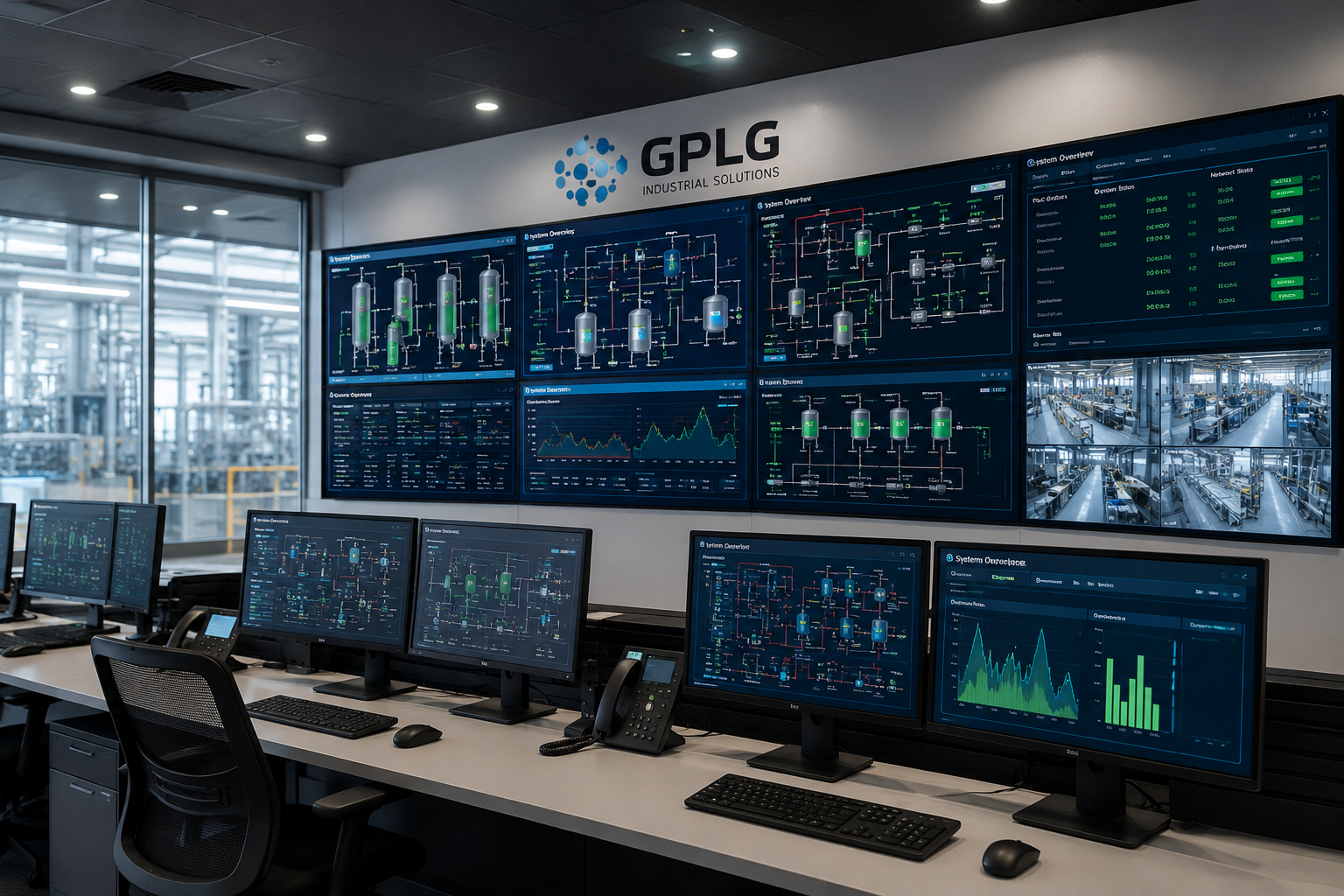
CENTRALISED SUPERVISION
Machines, process data and operational information in one supervision environment.
Bring selected information from production equipment, automation systems and process areas into a structured operational view.
FROM FIELD TO SUPERVISION
Connecting the industrial layers
A SCADA solution sits between the physical process and the people who need to supervise it. Its architecture depends on the equipment already installed, communication possibilities, operational requirements and the information that needs to be retained.
The exact architecture is defined for each installation. Existing equipment and communication infrastructure are assessed before deciding how data should be collected, transported, displayed and stored.
HUMAN-MACHINE INTERFACE
Information without unnecessary complexity
An HMI should help the operator understand the process quickly. Screen structure, navigation, symbols, status information and alarm presentation must remain consistent throughout the application.
GPLG develops interfaces around the operational hierarchy of the installation, from an overall process view to the detailed information required for individual machines or equipment.
Clarity
Present the information required for operation without filling screens with unnecessary visual elements.
Consistency
Use a coherent navigation and visual structure so operators do not need to relearn the interface from one area to another.
Context
Show values, states and alarms in relation to the equipment and process they belong to.
OPERATIONAL HISTORY
Know what happened and when
When a process stops or behaves unexpectedly, knowing that an alarm occurred is only the beginning. Operators and technicians also need to understand when it happened, which equipment was involved and what other events occurred around the same time.
A structured alarm and event system can provide this chronological context. Depending on the project requirements, alarms can be organised by equipment, process area, condition or priority, with acknowledgement and historical review available to authorised users.
Useful alarm management focuses attention on actionable conditions instead of overwhelming operators with repetitive information.
PROCESS BEHAVIOUR
See how the process changes over time
A live value shows the current condition. A trend shows how that condition developed.
Recording selected variables makes it possible to compare operating periods, investigate deviations and observe relationships between process values. This information can support maintenance, engineering analysis and continuous improvement activities.
Retention periods and sampling requirements are defined according to the purpose of the data and the practical requirements of the installation.
ENGINEERED FOR THE INSTALLATION
An architecture suited to the installation
There is no single SCADA architecture suitable for every factory. A standalone machine, a production line and a multi-area installation have different requirements for communication, availability, users and data retention.
Before development, GPLG assesses the available control systems, communication protocols, required data points, operator roles, historical requirements and access needs. The resulting architecture can then be designed around the real installation instead of forcing the installation into a generic template.
Communication
Identify available interfaces and the most appropriate way to exchange industrial data.
Users
Define operational access according to the people and responsibilities involved.
Data
Determine which information needs to be live, historised or available for analysis.
Deployment
Select an architecture appropriate to the size, organisation and operational requirements of the installation.
FROM ASSESSMENT TO COMMISSIONING
SCADA engineering as part of the complete automation system
Process assessment
Understand the installation, operating requirements and information needed by the people who use the system.
Architecture
Define data sources, communications, SCADA structure, users and historical requirements.
Development
Build process screens, navigation, alarms, trends and required data handling.
Integration
Connect the SCADA application with the relevant industrial control and information systems.
Testing and commissioning
Verify communications, values, commands, alarms and behaviour against the actual installation.
Support and evolution
Adapt the system as equipment, production requirements and operational needs change.
EXISTING SYSTEMS
Modernising existing SCADA installations
Not every SCADA project starts with a new production line. Existing installations may have supervision systems that no longer reflect the current process, contain fragmented screens, provide limited historical information or have become difficult to maintain.
GPLG can assess the existing supervision environment and define a modernisation approach based on the equipment and infrastructure already in place. Depending on the project, this may involve restructuring screens, reviewing alarms, improving data organisation, integrating additional equipment or developing a new supervision layer.
Modernisation should be planned around production constraints and the technical reality of the installation, with particular attention to interfaces with existing control equipment.
CONNECTED ENGINEERING
SCADA does not operate in isolation
Supervision is one layer of a wider industrial architecture. Explore technologies commonly connected with SCADA engineering.
PLC Programming
Control logic and machine-level integration.
Explore →OPC UA & MQTT
Industrial communication and structured data exchange.
Explore →Industrial IoT
Connecting industrial information across systems and applications.
Explore →Database Solutions
Structured storage and access to operational information.
Explore →SCADA ENGINEERING
Need clearer visibility of your industrial process?
Whether you are developing a new installation or reviewing an existing supervision system, GPLG can assess the process, control architecture and operational requirements before defining the appropriate SCADA solution.