






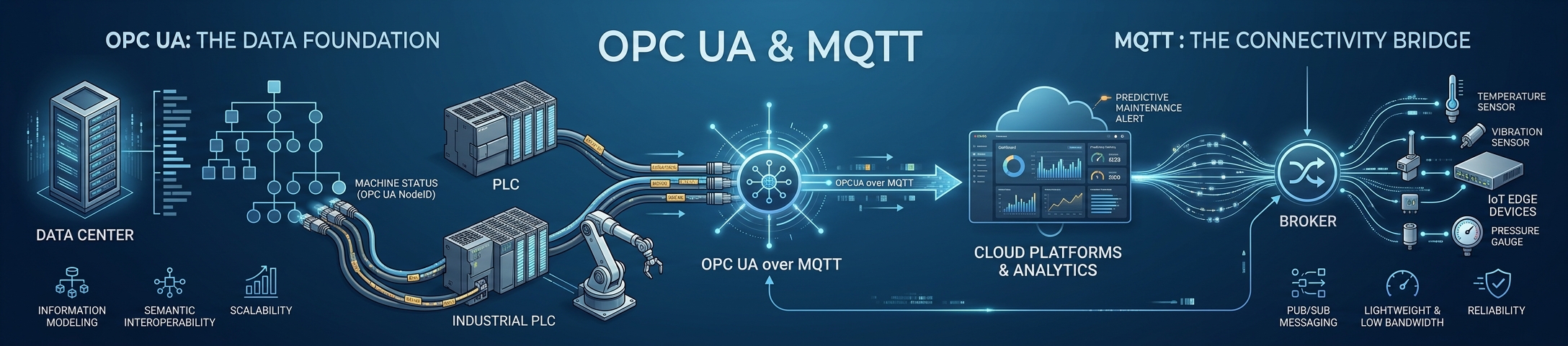
Connecting Machines, Automation Systems and Industrial Software
GPLG implements industrial communication architectures using technologies such as OPC UA and MQTT to connect machines, PLCs, sensors and software systems.
We design communication solutions around the requirements of the industrial environment, from machine-level connectivity to data exchange between production systems and higher-level applications.
Industrial Communication Architectures
Modern production environments rarely consist of a single machine or automation system. Systems need to exchange information reliably across every operational layer:
OPC UA for Industrial Communication
OPC UA (Open Platform Communications Unified Architecture) is an industrial communication framework designed for reliable and structured exchange of information between systems and devices. It provides a standardised way for industrial applications to communicate with equipment and automation systems.
MQTT for Industrial Data Exchange
MQTT (Message Queuing Telemetry Transport) is a lightweight publish/subscribe messaging protocol designed for efficient data distribution across connected devices and software. By leveraging a central broker, it eliminates the need to maintain direct peer-to-peer connections between every system component.
Different Technologies for Different Requirements
| Feature | OPC UA | MQTT |
|---|---|---|
| Main purpose | Industrial system communication | Message/data distribution |
| Communication model | Client / Server | Publish / Subscribe |
| Typical environment | Machines, PLCs, SCADA | IoT, edge and distributed systems |
| Data structure | Rich industrial information model | Lightweight messages |
| Typical use | Machine/system integration | Data distribution |
| Architecture | Direct system communication | Broker-based communication |
Combining OPC UA and MQTT
Designing the Communication Layer
GPLG doesn't simply install a protocol. We first evaluate key architectural requirements before designing the appropriate communication infrastructure:
Integrating OPC UA Into Industrial Systems
GPLG implements OPC UA communication as part of machine and automation integration projects. Depending on the equipment, the integration architecture may involve the following key components and execution phases:
Implementing MQTT in Industrial Environments
MQTT implementations typically involve:
Devices or applications that publish information.
The central component responsible for receiving and distributing messages.
Applications or systems that receive specific information.
Topics
Logical channels used to organise industrial messages.
factory/line01/machine03/temperature
factory/line01/machine03/production
factory/line01/machine03/alarm
This structure allows information to be distributed without creating individual point-to-point connections between every system.
From Machine Signal to Software Application
Industrial Communication for Existing Machines
Many production environments contain equipment from different manufacturers and generations.
A machine does not necessarily need to be replaced simply because it does not support modern communication technologies.
GPLG can assess existing equipment and determine how information can be extracted and integrated into a modern communication architecture.
Connecting PLC Systems to Higher-Level Applications
OPC UA provides a structured communication layer between PLC-controlled equipment and higher-level software platforms.
Industrial Supervision and Data Exchange
OPC UA forms the critical communication backbone connecting industrial machinery directly to supervisory software.
Connecting Industrial Data to IoT Architectures
MQTT is particularly useful when industrial information needs to be distributed efficiently across multiple software or IoT components.
Industrial Communication Must Be Designed Securely
Industrial connectivity must take into account more than simply whether data can be exchanged. GPLG considers key architectural and operational factors to ensure secure implementation:
- Network Segmentation — Isolating critical control networks from enterprise and external systems.
- Authentication — Verifying identities of all communicating devices, brokers, and software systems.
- Access Control — Enforcing least-privilege policies to limit operational capabilities per system.
- Encryption — Protecting sensitive data in transit and at rest where appropriate.
- Device Exposure — Minimizing attack surfaces and hardening edge equipment against unauthorized access.
- Broker Security — Hardening central messaging hubs with robust policies and monitoring.
- User Permissions — Restricting operator and administrative actions to authorized personnel only.
- Communication Paths — Auditing and securing explicit end-to-end data routes.
- Industrial Network Architecture — Designing resilient topology suited for operational environments.
Before We Implement the Protocol
We evaluate the existing environment first across key operational dimensions:
- Existing Equipment — Identifying installed machines, PLCs, and controllers.
- Available Communication — Assessing available protocols and interfaces.
- Data Requirements — Defining specific information that needs to be exchanged.
- Destination — Mapping where data must be transmitted.
- Performance — Determining required exchange speed and frequency.
- Architecture — Selecting direct, broker-based, edge-based, or hybrid models.
Industrial Communication & Integration
Where We Use OPC UA & MQTT
Communication Designed Around the Application
We don't choose OPC UA or MQTT simply because they are widely used technologies. Every protocol selection is driven by what the industrial system actually requires.
Connect Your Industrial Systems
Whether you need to connect a PLC to software, integrate existing machinery, build an Industrial IoT architecture or exchange data between multiple industrial systems, GPLG can design and implement the appropriate communication layer.