





Python Development for Industrial Automation
Industrial software, automation tools and intelligent applications developed with Python.
We use Python to connect software development with real industrial processes.
Python Applied to Industrial Engineering
Its flexibility allows engineers to create applications for data processing, automation, machine communication, computer vision, optimisation and intelligent manufacturing.
At GPLG, we use Python where it provides a practical advantage within an industrial application.
Rather than developing software in isolation, we consider how the application will interact with the machines, production environment and wider automation architecture.
Python Applications for Industrial Environments
Industrial Automation Tools
Python applications developed to support specific automation and manufacturing requirements.
These can include engineering utilities, process tools and custom automation applications.
Data Processing
Python can process large amounts of industrial information and transform raw data into useful engineering or production information.
Computer Vision
Python can be used to develop image-processing and machine-vision applications for industrial inspection and object analysis.
Intelligent Applications
Python provides access to a broad ecosystem of machine-learning and AI technologies that can be applied to specific industrial requirements.
Engineering Software
Custom engineering utilities can automate repetitive calculations, data processing and technical workflows.
Manufacturing Applications
Python can support specialised software applications around production, machining, robotics and industrial processes.
Flexible Software for Complex Engineering Requirements
Industrial environments often generate requirements that cannot be solved by standard automation software alone.
Python provides a flexible development environment for creating applications that can:
- Process industrial data
- Automate engineering tasks
- Analyse images
- Communicate with systems
- Perform calculations
- Process large datasets
- Run optimisation algorithms
- Connect different software components
- Support machine-learning applications
The technology is selected according to the actual requirements of the project.
Software Around the Automation System
The exact architecture depends on the equipment, communication requirements and purpose of the application.
PYTHON DEVELOPMENT PROCESS
From Engineering Requirement to Industrial Application
01 — Requirement Analysis
We define what the application needs to accomplish and how it will interact with the industrial environment.
02 — Architecture
We establish the software structure, modules, interfaces and communication requirements.
03 — Development
Python applications are developed using structured and maintainable programming practices.
04 — Integration
The application is connected with the required equipment, software or data sources.
05 — Testing
Functions and communication are tested under controlled conditions.
06 — Deployment
The application is configured and deployed in the target environment.
07 — Optimisation
Performance and functionality can be refined according to real operating conditions.
PYTHON SOFTWARE ARCHITECTURE
Python applications should not become a collection of scripts that only one engineer understands.
GPLG develops applications with structured software architecture.
For example:
User Interface
      ↓
Application Logic
      ↓
Engineering / Business Logic
      ↓
Data & Processing
      ↓
Communication Layer
      ↓
Industrial Equipment
This approach helps separate the different responsibilities of the application and makes future maintenance and development easier.
Modular
Functions are separated into logical components.
Maintainable
The code structure remains understandable as the application grows.
Reusable
Common functionality can be reused where appropriate.
Scalable
The architecture can accommodate additional functionality.
PYTHON FOR CNC
Python can be used to develop supporting tools around CNC programming and machining operations.
Potential applications include:
- CNC program utilities
- Automated calculations
- Program preparation
- Parameter processing
- Manufacturing data processing
- Engineering tools
- Production utilities
- Custom CNC workflows
Python does not replace the CNC controller.
Instead, it can provide an additional software layer around the machining process, automating tasks that would otherwise require repetitive manual work.
PYTHON FOR ROBOTICS
Python can also be used within robotic and automated production environments.
Depending on the robot and system architecture, Python applications can support:
- Data processing
- Robot-related utilities
- Vision processing
- Simulation
- Production logic
- External system communication
- Engineering tools
The actual robot motion and safety functions remain dependent on the robot controller and system architecture.
From Images to Industrial Information
Python provides a powerful environment for image processing and computer vision.
Industrial applications can use cameras to capture information about products, components or production processes.
A typical workflow can be:
Industrial Camera
       ↓
Image Acquisition
       ↓
Python Processing
       ↓
Computer Vision
       ↓
Decision
       ↓
Industrial System
Applications may include:
- Object detection
- Classification
- Presence/absence inspection
- Position detection
- Measurement
- Surface inspection
- Part identification
For the dedicated Machine Vision page, we can go much deeper into cameras, lighting, algorithms and inspection systems.
Turning Industrial Data Into Useful Information
Industrial systems can generate significant amounts of information.
Python can process this information to perform:
- Data transformation
- Calculations
- Statistical analysis
- Report generation
- Trend analysis
- Data validation
- Automated processing
The purpose is not simply to collect more data.
It is to turn the data into information that can support engineering and operational decisions.
A Development Platform for Intelligent Systems
Python is widely used for machine learning and artificial intelligence applications.
At GPLG, Python can be used as part of intelligent industrial solutions involving:
- Machine learning
- Computer vision
- Predictive models
- Classification
- Pattern recognition
- Process optimisation
However, the AI model is only one component of the solution.
The complete system must also consider:
Data → Model → Application → Industrial Environment
This is where industrial engineering becomes important.
PYTHON + INDUSTRIAL COMMUNICATION
Connecting Python to Industrial Systems
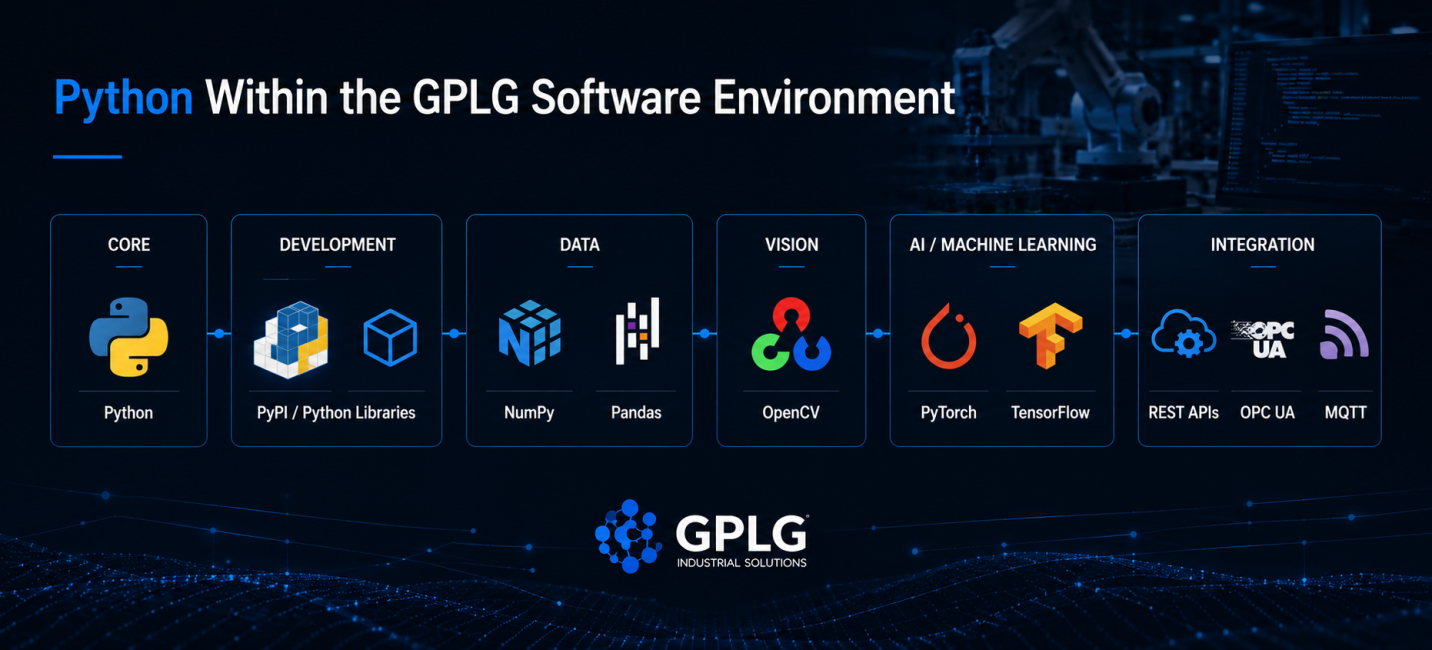
Python applications can communicate with industrial equipment and software systems through appropriate communication technologies.
Depending on the project, this can include communication with:
PLC systems
CNC equipment
Industrial devices
Software applications
Data systems
The communication architecture is selected according to the equipment and requirements of each project.
PYTHON APPLICATION AREAS
Where We Apply Python
Industrial Automation
Custom applications supporting automation systems.
CNC & Manufacturing
Engineering and manufacturing utilities around CNC processes.
Machine Vision
Industrial image processing and inspection.
Robotics
Software tools and processing around robotic systems.
Engineering
Custom engineering applications and automation utilities.
Intelligent Systems
Machine-learning and AI applications for industrial environments.
ENGINEERING PRINCIPLES
Python Development Built for Industrial Environments
Practical
We use Python where it provides a genuine technical advantage.
Structured
Applications are developed using organised software architectures.
Maintainable
Code should remain understandable and manageable over the life of the project.
Integratable
Python applications can be designed to operate within larger industrial architectures.
Scalable
Solutions can evolve as the application requirements grow.
Engineering Focused
Software development is driven by the actual industrial problem—not by technology for its own sake.
Build the Software Your Industrial Process Requires
From engineering utilities and CNC applications to machine vision and intelligent systems, GPLG develops Python software designed around real industrial requirements.