





Machine Vision Systems & Industrial Integration
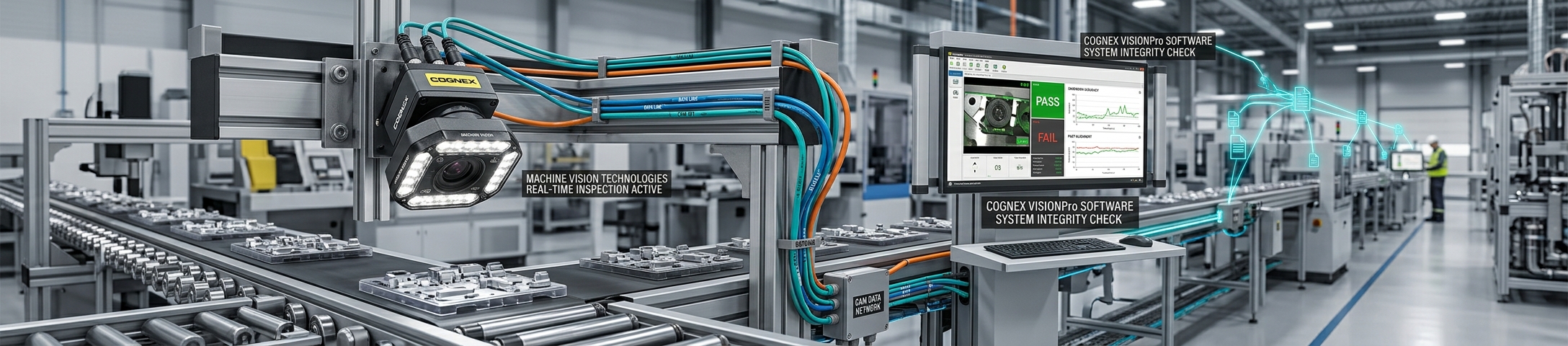
GPLG designs and integrates machine vision systems that allow industrial equipment to capture, analyze, and act on visual information in real time.
🔍 Optics
💡 Lighting
🧠 Image Processing
⚡ Industrial Automation
MACHINE VISION ENGINEERING
Machine vision transforms images captured by industrial cameras into information that can be used by machines, software and automation systems. A complete vision system is much more than a camera.
The performance of the application depends on the correct combination of optical elements, hardware acquisition, and automated decision-making.
GPLG engineers the complete system around the characteristics of the product, production environment and inspection requirement. Every variable is accounted for to guarantee absolute repeatability.
From Image to Industrial Decision
A machine vision system captures visual information, processes the image, and produces a real-time result utilized by the broader industrial automation infrastructure.
Engineering the Complete Vision System
Selecting the Right Industrial Camera
There is no single camera that is ideal for every application. GPLG evaluates the specific demands of each deployment to obtain the required image quality—not simply the highest specification available.
The Lens Is Part of the Measurement System
A high-quality camera cannot compensate for an unsuitable lens. Optical accuracy directly defines system performance.
Controlling the Image Before Processing It
Lighting determines what the camera can actually see. Different materials, surface finishes, and component geometries demand specific lighting techniques to highlight key features and eliminate unwanted visual noise.
Capturing Consistent Images at Production Speed
Industrial inspection demands highly repeatable image acquisition. To prevent variability, image acquisition is precisely engineered around the physical dynamics of the actual production cycle.
Extracting Information From Images
Once an image is captured, the system extracts the critical visual data. GPLG selects and combines the appropriate algorithmic approaches based specifically on the inspection goals.
MACHINE VISION ENGINEERING
Machine vision transforms images captured by industrial cameras into information that can be used by machines, software and automation systems. A complete vision system is much more than a camera.
The performance of the application depends on the correct combination of optical elements, hardware acquisition, and automated decision-making.
GPLG engineers the complete system around the characteristics of the product, production environment and inspection requirement. Every variable is accounted for to guarantee absolute repeatability.
Automated Visual Quality Control
Machine vision can automate inspections that would otherwise require manual visual checking. Applications may include:
Vision-Based Measurement
Machine vision performs non-contact measurements when the application and optical configuration are properly suited. Accuracy depends on the complete optical and imaging system, precision calibration, and controlled application conditions.
Finding and Identifying Objects
Vision systems reliably locate and identify objects within a defined inspection area. For robotic applications, the system provides precise spatial coordinates required for automated guidance and pick-and-place handling.
Connecting Vision With Robotic Automation
This is where Machine Vision connects directly to your Robotics Integration service. Vision-guided robotics allows automated systems to respond dynamically to objects whose position or orientation may vary on the production line.
Integrating Inspection Results With Automation
A machine vision system often needs to communicate its result directly to the machine control system. The PLC remains responsible for the deterministic machine-control logic while the vision system provides the visual information required by the application.
Bringing Vision Information Into Software
Vision results can also become part of wider industrial applications. Integrating visual inspection data directly into higher-level management systems transforms isolated image captures into actionable production insights across the enterprise.
Where We Apply Machine Vision
Automated visual inspection of products and components to detect surface defects, material flaws, and assembly errors at production line speeds.
Recognition and classification of parts and products using optical character recognition (OCR), 1D/2D barcodes, and feature matching.
Non-contact dimensional and positional measurement ensuring exact physical tolerances and real-time geometric verification without part contact.
Providing robots with real-time object location and orientation coordinates for precise pick-and-place, assembly, and path correction.
Visual classification for automated sorting, categorizing items dynamically based on color, shape, size, or specific visual criteria.
Verification of assembly integrity, component presence, orientation, label positioning, and active process conditions in real time.
From Inspection Requirement to Production System
Delivering a reliable machine vision solution requires a structured engineering roadmap—moving sequentially from early stage feasibility testing to full-scale industrial commissioning.
Designed for Real Production Conditions
A vision system must work consistently—not only when the lighting and product are perfect. GPLG designs and validates each system around the actual operating environment to ensure robust long-term performance.
Machine Vision Technology Stack
A Camera Is Only One Part of the Solution
A successful industrial vision project depends on the complete system. GPLG engineers these components together rather than treating the camera as an isolated device.
Give Your Industrial System the Ability to See
From automated inspection and measurement to object recognition and robotic guidance, GPLG designs machine vision systems around real production requirements.