







bg test 12

Scada Systems

scada

Supervision, Monitoring and Control for Industrial Operations

SCADA systems provide a central interface for monitoring and supervising industrial processes, giving operators clear visibility of machine status, production conditions, alarms and operational data.

GPLG develops SCADA solutions designed around the structure and requirements of each industrial process.


WHAT SCADA DOES

From Industrial Data to Operational Information

A SCADA system continuously collects information from the industrial environment and transforms it into information that operators and engineers can use.

Real-Time Monitoring

Visualisation of machine and process conditions as they happen.

Operators can monitor:

  • Machine states
  • Process values
  • Production status
  • Temperatures
  • Pressures
  • Speeds
  • Levels
  • Equipment status

Alarm Management

SCADA provides structured visibility of abnormal conditions.

Alarm systems can include:

  • Alarm priorities
  • Alarm history
  • Acknowledgement
  • Event timestamps
  • Operator notifications
  • Diagnostic information

The objective is not simply to display an alarm, but to provide enough information to understand what requires attention.

Process Visualisation

Complex industrial processes are represented through intuitive graphical interfaces.

Depending on the application, screens can include:

  • Process diagrams
  • Machine layouts
  • Equipment status
  • Production counters
  • Trends
  • Parameters
  • Operating modes

Historical Data

SCADA can store and visualise historical process information, allowing engineers and operators to analyse what happened over time.

Examples include:

  • Production trends
  • Temperature history
  • Machine cycles
  • Alarm history
  • Process values
  • Equipment performance

SCADA ARCHITECTURE

HIERARCHICAL CONTROL LAYER
Designed as an Industrial Control Layer

A robust supervisory architecture seamlessly bridges field-level automation with operator control and long-term data collection.
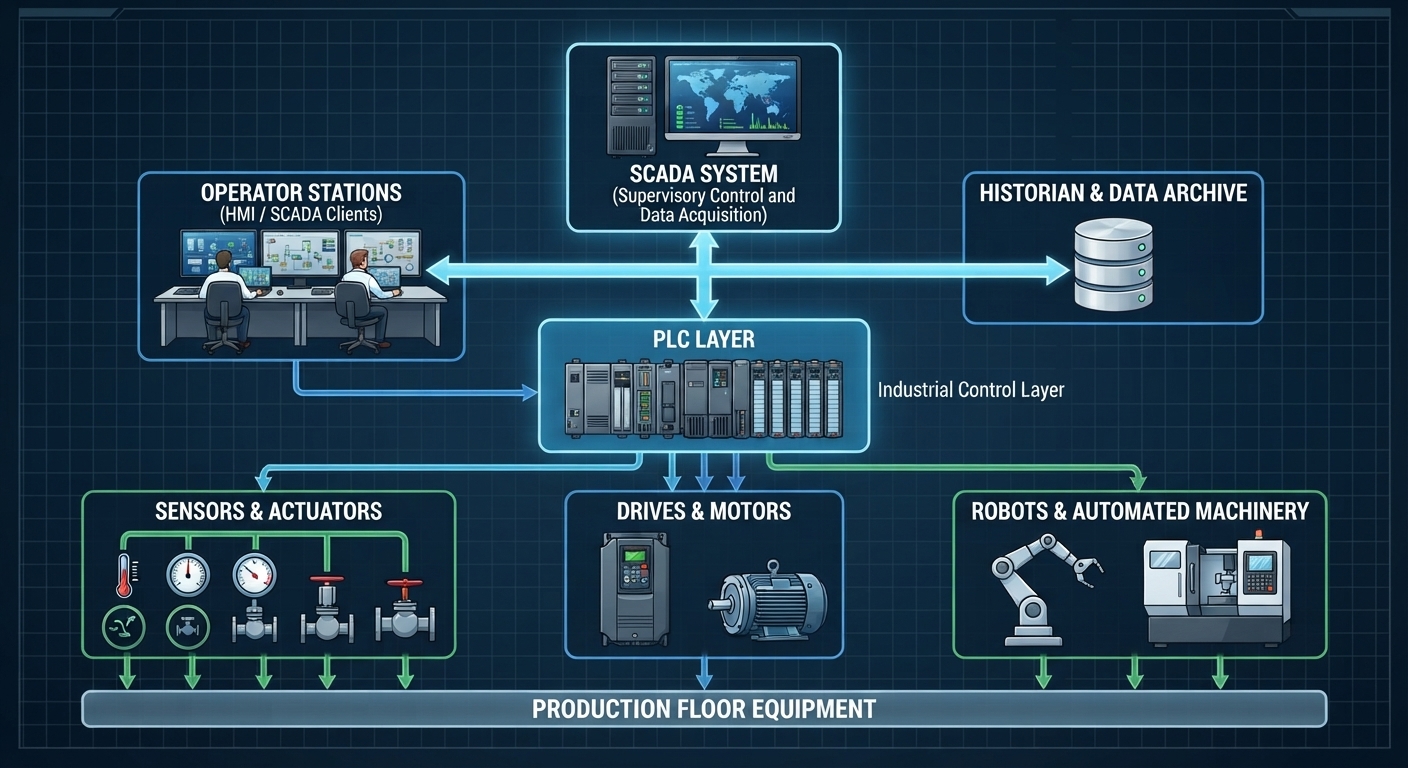
SCADA
Operator Stations
Historian
PLCs
Sensors
Drives
Robots
PRODUCTION ENVIRONMENT

GPLG ARCHITECTURE
GPLG designs SCADA architectures according to the scale and requirements of the installation. From a single machine interface to multi-line industrial monitoring systems, the architecture is designed to remain structured, reliable and scalable.

scada aechitecture

SCADA ENGINEERING

HMI VS SCADA ARCHITECTURE

SYSTEM DISTINCTION HMI and SCADA Are Not the Same

Although HMI and SCADA systems are closely related, they normally serve different operational purposes across the plant floor:

LOCAL HMI Primarily provides an interface for operating and interacting with an individual machine or local process.
SUPERVISORY SCADA Provides broader supervision and monitoring across machines, production lines or industrial processes.
HIERARCHICAL FLOW Integrated Architecture
Machine
HMI
PLC
Industrial Network
SCADA
Plant Monitoring
GPLG ENGINEERING
GPLG can design the relationship between local machine interfaces and plant-level supervision according to the requirements of the installation.

SCADA APPLICATION DEVELOPMENT

ENGINEERING METHODOLOGY Beyond Attractive Screens

SCADA development is more than creating visual graphics. The application must accurately represent the actual behavior of the industrial process under all operating conditions.

Process Structure We organize the application according to the physical and functional structure of the plant.
Graphic Development Process screens are designed to provide clear visual feedback without overwhelming the operator.
Tag Management Variables are structured consistently so that signals, equipment and process values remain easy to identify and maintain.
SUPERVISORY CONTROLS Data, Alarms & Security
Alarm Configuration Alarm conditions are structured according to the importance and behavior of the process.
Trends & Historical Data Relevant process values can be recorded and presented through historical trends.
User Management Access levels can be configured according to operator, maintenance and engineering responsibilities.
GPLG STANDARD
Robust application design ensuring operational visibility, diagnostic clarity, and system security.

TRENDS & PROCESS DATA

ANALYTICAL VISIBILITY See How the Process Changes Over Time

Real-time values show what is happening now. Historical trends show what happened before. SCADA applications can provide graphical analysis of process variables such as:

Temperature Thermal profiling
Pressure Fluid/pneumatic metrics
Speed Kinetic performance
Flow Volume & throughput
Production Rate Output velocity
Energy Consumption Power tracking
Machine Cycle Time Efficiency auditing
DIAGNOSTIC INSIGHT Behavioral Analysis

Static readings only tell part of the story. Capturing continuous time-series data transforms isolated values into actionable operational intelligence.

DATA VISIBILITY MODEL
Instantaneous Snapshots Only
↓ (Replaced By)
Continuous Historical Trend Analysis
ENGINEERING VALUE
This allows operators and engineers to identify changes in process behaviour and investigate abnormal conditions.

ALARM & EVENT MANAGEMENT

DIAGNOSTIC VISIBILITY Know What Happened and When

Alarm and event management is an essential part of an industrial SCADA application, ensuring rapid fault identification and resolution.

Priority Severity sorting
Equipment Asset tracking
Process Area Plant zoning
Timestamp Precise timing
Current Status Active / Cleared
Acknowledgement Operator response
Historical Events Long-term audit logs
SYSTEM INTEGRITY Structured Event Logging

Unstructured alarm floods overwhelm operators. GPLG structures alarm systems around operational context, priority, and clear lifecycle tracking.

ALARM MANAGEMENT MODEL
Unfiltered Alarm Floods
↓ (Replaced By)
Structured Priority & Event Tracking
THE GPLG STANDARD
This creates a chronological record of abnormal conditions and operator interactions.

UNIFIED SUPERVISORY CONTROL (SCADA)

HIERARCHICAL TOPOLOGY One Interface for Multiple Production Areas

For larger industrial installations, SCADA provides a centralized, unified view across distributed machines and cells.

SUPERVISORY LAYER
SCADA
LINE 01
PLC → Mach.
LINE 02
PLC → Mach.
LINE 03
PLC → Mach.
OPERATIONAL CONSISTENCY Seamless Plant Supervision

Fragmented monitoring forces operators to interpret disparate interfaces for each manufacturing cell, increasing cognitive load and error risk. Centralizing control eliminates these barriers.

MONITORING MODEL
Fragmented HMI Dashboards
↓ (Replaced By)
Unified Multi-Cell SCADA Environment
THE GPLG ADVANTAGE
“This allows operators and engineers to move between production areas while maintaining a consistent supervisory environment.”

SCADA & HMI PLATFORMS

PROVEN DEPLOYMENTS SCADA Platforms We Implement

Rather than listing every available market solution, we focus strictly on the industrial SCADA and HMI platforms we have hands-on experience configuring, programming, and deploying across real production environments:

Siemens WinCC
AVEVA System Platform
AVEVA InTouch
Ignition
Rockwell FactoryTalk View
Schneider EcoStruxure
COPA-DATA zenon
ENGINEERING GOVERNANCE Matched to Plant Requirements

GPLG selects and implements supervisory software based entirely on the specific demands of each plant architecture, existing hardware footprint, and long-term operational roadmap.

SELECTION CRITERIA
Generic Software Catalogs
↓ (Replaced By)
Platform Experience & Proven Capability
FOCUSED SCOPE
For a broader view of programming languages and system tools, visit our dedicated Technologies section.

SCADA INTERFACE DESIGN

ERGONOMIC ENGINEERING Information Without Unnecessary Complexity

A good SCADA interface should allow an operator to understand the state of a process quickly and make informed decisions under pressure.

Clear hierarchy Important information visible.
Consistent navigation Intuitive screen flow.
Visual status Unified condition feedback.
Meaningful alarms Actionable diagnostics.
Operational simplicity No unnecessary visual clutter.
OPERATOR EXPERIENCE Human-Centric Design

By eliminating cognitive overload and prioritizing high-visibility indicators, control rooms maintain peak situational awareness during normal operations and critical events.

VISUAL DESIGN MODEL
Cluttered Multi-Screen Dashboards
↓ (Replaced By)
Streamlined Hierarchical Interface
GPLG STANDARD
Designing clean, effective interfaces tailored to plant operator requirements.

SCADA INTEGRATION

SYSTEM CONNECTIVITY Designed to Connect

SCADA systems can be integrated with the wider industrial environment when required. Depending on the project architecture, this can include:

PLC Industrial control and machine status.
Industrial Networks Communication between automation systems.
Databases Storage and retrieval of selected production information.
Higher-Level Systems Integration with other industrial or business applications.
ARCHITECTURE SCOPE Tailored Connectivity

Seamless data exchange across the automation pyramid requires precise protocol selection and network planning to prevent bottlenecks and ensure real-time responsiveness.

INTEGRATION MODEL
Isolated Data Silos
↓ (Replaced By)
Unified Multi-Tier Architecture
GPLG STANDARD
The integration architecture is defined according to the requirements of the specific installation.

SCADA FOR EXISTING SYSTEMS

LEGACY UPGRADES Modernising Existing SCADA Applications

Existing SCADA systems often evolve over many years. GPLG can assess existing applications and identify opportunities for modernisation, covering:

Interface redesign Modern UI/UX
Alarm restructuring Priority rationalisation
Application optimisation Performance tuning
New machine integration Asset expansion
Additional monitoring Broader visibility
System migration Platform upgrades
Improved diagnostics Faster troubleshooting
Expansion Scaling capacity
STRATEGIC CONTINUITY Preserving Operational Knowledge

Upgrading legacy infrastructure should never mean losing the hard-earned operational insights and process rules embedded over years of plant operation.

MODERNISATION APPROACH
Fragmented Legacy Systems
↓ (Transformed Via)
Optimised Supervisory Control
THE GPLG OBJECTIVE
The objective is to improve the supervisory system while preserving the operational knowledge already embedded in the installation.

SCADA ENGINEERING PRINCIPLES

FOUNDATIONAL GUIDELINES Core Engineering Principles

GPLG applies rigorous engineering standards to every supervisory project, ensuring long-term reliability, scalability, and operator clarity.

Process First The SCADA architecture starts with understanding the process.
Structured Applications Screens, tags, alarms and functions are organised consistently.
Operator Focus Information is presented according to what operators actually need.
LIFECYCLE EXCELLENCE Scalable & Maintainable Design
Scalable Architecture The system can accommodate additional machines and production areas.
Maintainable Development Applications are structured so future engineers can understand and modify them.
GPLG COMMITMENT
Delivering robust, transparent, and future-proof industrial supervisory solutions.

A Clearer View of Your Industrial Process

GPLG develops SCADA systems that transform industrial process data into clear, structured and actionable information.

From individual machines to complete production environments, we engineer supervisory systems around the way your operation actually works.

Discuss Your SCADA Project

Request a Technical Consultation

Share with